Black Hat Asia 2025 — Field Notes from the Frontlines: A Fintech DevOps Debrief
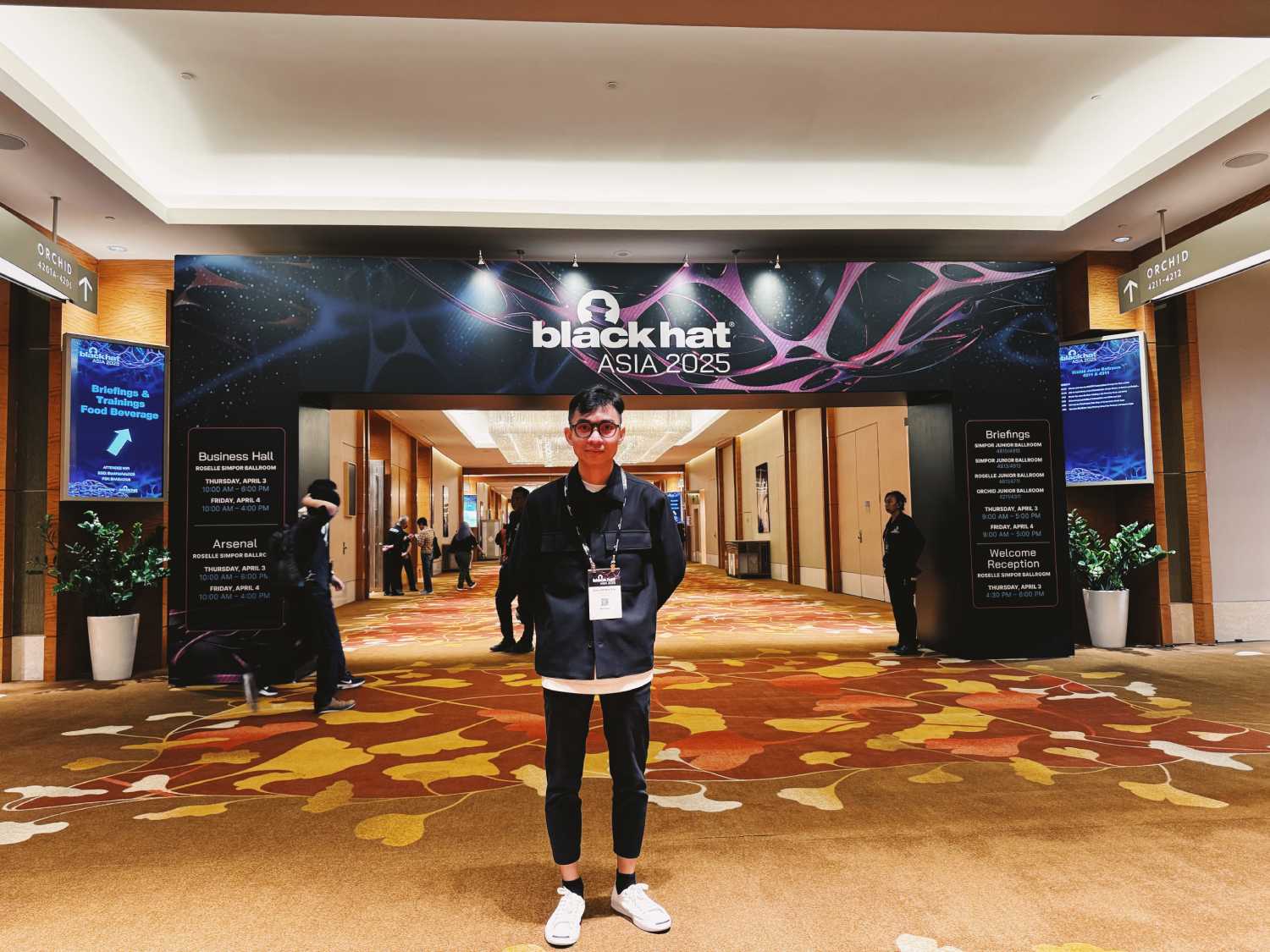

Introduction – Why Fly to the Frontlines? 🛡️
Certifications validate what you know. Threat intelligence is perishable — it expires the moment the next campaign drops. That gap is exactly why I made the trip to Black Hat Asia 2025. As a DevOps and Security Engineer hardening cloud and on-prem infrastructure for a regulated, frequently air-gapped banking environment at company, I didn't want the recap blog. I wanted the threats firsthand, in the room, from the people tracking them. This is my debrief — not a vendor pitch, but a field engineer's notebook: what I heard, and what each session means when you have to translate it into hardening decisions on Monday morning.
1. The Journey There ✈️
From Phnom Penh to Marina Bay Sands — a short flight, a different altitude entirely. Black Hat Asia ran April 1–4, 2025, with the Briefings on April 3–4, and the room was packed: roughly eighteen hundred practitioners, researchers, and defenders converging on Singapore for Asia's largest cybersecurity gathering. Walking into the Sands Expo with a badge and a notebook, you feel the asymmetry of this work immediately — the offensive talent in the room is staggering, and the defenders are outnumbered. That feeling never really leaves. It sharpens you. Here's what I carried home.
2. The Opening – AI Is Not a Zero-Sum Game 🧠
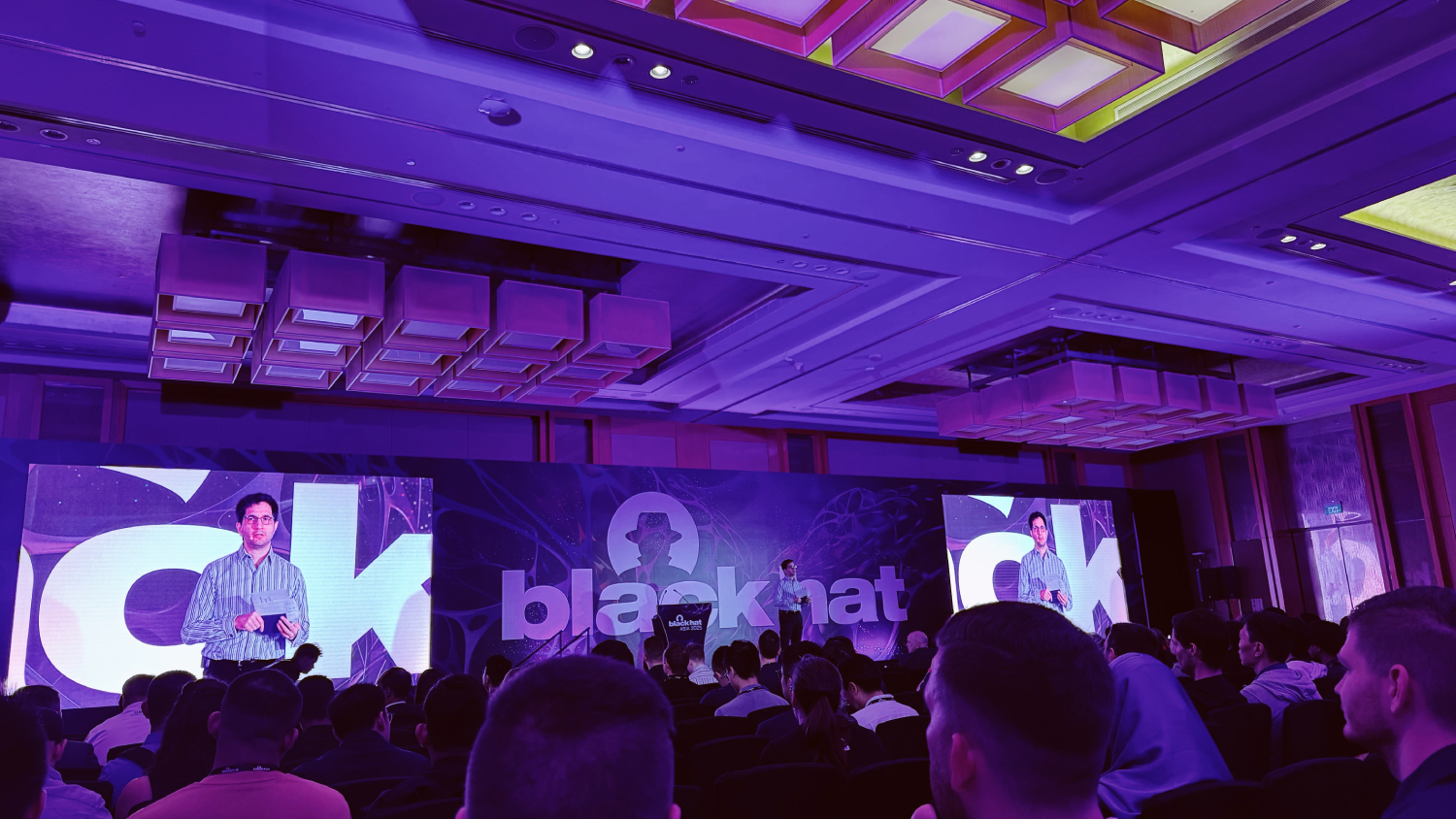
Jeff Moss, the founder of Black Hat, set the tone. He talked about how fast technology is transforming everything — and how even the enthusiasts can no longer keep pace. His framing of AI and AGI across government, politics, and the enterprise stuck with me: this is not a zero-sum game. It isn't a clean win-or-lose between attackers and defenders; it's a messy, simultaneous interplay where the same capability lifts both sides at once. For an engineer, that reframes the whole AI conversation. The model that writes your boilerplate is the same class of model writing the adversary's tooling. AI isn't a feature you bolt on — it's a dual-use capability you have to govern. 🔒 Debrief for the enterprise. Treat AI adoption like any other privileged capability: scope it, log it, and assume your adversary has the same tool. The advantage goes to whoever governs it with more discipline, not whoever adopts it fastest.
3. Singapore's Threat Landscape 🇸🇬
Mr. Edward Chen, Deputy Chief Executive (National Cyber Resilience) at the Cyber Security Agency of Singapore, grounded the abstractions in regional reality. Three threats led his briefing. First, ransomware, climbing roughly 20% year over year — still the workhorse of organized cybercrime. Second, scams, with a twist that should worry everyone in the region: malicious actors are standing up infrastructure inside Singapore and using it as a proxy to defraud other countries. The clean jurisdiction becomes the launchpad. Third, APTs running cross-platform malware orchestration — adversaries no longer constrained to one OS or one foothold. Sitting there as someone who defends a bank in the same neighborhood, the proxy-infrastructure point landed hardest. Regional proximity means a shared blast radius. 🔒 Debrief for the enterprise. Geography is part of your threat model. Assume your upstream providers and regional neighbors are active targets, and design so that their compromise doesn't become your incident.
4. AI: Now Smarter Than Hackers, But Still Confused by Cats
Best title of the conference, and one of the most useful talks. Vandana Verma Sehgal — an OWASP leader and a voice from Snyk on application and cloud security — walked the room through the OWASP Top 10 for LLMs. The ones I underlined: Model Denial of Service, Supply Chain vulnerabilities, and Sensitive Information Disclosure. Her point about AI's limitations was the honest part nobody likes to say out loud: these systems lack real contextual understanding, they're only as good as their training data, and they fall apart on ambiguity. Smarter than a hacker at some tasks — and still, fundamentally, confused by cats. Her prescription for securing AI systems was pure zero-trust: build resilient AI, validate everything, collaborate across teams, and stay proactive. The line I wrote down and kept circling: "Don't trust. Verify." Treat AI-generated code as if it came from an inexperienced junior who's never seen your threat model. Test and validate all of it. Pair your Copilot and ChatGPT output with AST and SAST tooling right there in the IDE — before it ever reaches a branch. 🔒 Debrief for the enterprise. AI output is untrusted input — gate it through review and AST/SAST, never merge it raw. Pin and verify every dependency. In an air-gapped build, nothing reaches production from a public registry without passing an internal mirror and a signature check first.
5. Modern Defense – Recon Beats Expensive Scanners 🔎
The most practical session of the week came from Andy Cao, COO at ProjectDiscovery. His thesis is one every blue team should internalize: you don't need a six-figure scanner or a 9.8 CVE to get breached — or to defend. Proper reconnaissance is the real edge. He walked through the open-source toolchain that's become the community standard for exposure discovery: subfinder for attack-surface and subdomain mapping, naabu for fast port and service scanning, and nuclei for YAML-template-based detection. His framing — drawn from the lessons of the DeepSeek exposure — was blunt: legacy scanners aren't enough, security can't be limited to CVEs, and continuous monitoring of misconfigurations and parameters is what actually catches real-world risk. Nuclei's superpower is that its detection templates are community-powered, so they catch the misconfigurations that CVE-focused, vendor-driven tools miss entirely. 🔒 Debrief for the enterprise. Adopt the recon-first mindset — but run it from a hardened, internally-mirrored toolbox. Pin tool versions, verify checksums and signatures, and review template feeds before you trust them. For air-gapped UAT, those feeds get pulled, reviewed, and synced offline — never executed live from the internet.
6. The Illusion of Isolation – Your CI/CD Is an Attack Surface ⚙️
This was the talk that hit closest to my day job. The research presented a simple, uncomfortable truth: most CI/CD security research chases visible workflow flaws, while the real danger is the platform's isolation between agent and server. When that separation is weak, you get sensitive-data exposure and remote code execution — straight into the system that holds every secret you own. The case studies were a roll call of pipeline pain. Atlassian Bamboo — command injection via insufficient input sanitization in build scripts. GoCD — a flawed HTTP request filter allowing unauthenticated RCE through add-on endpoints. GitLab Runner — CVE-2024-9164, privileged-container escape to the host when misconfigured with the --privileged flag or shared runners. Jenkins fared better — sandboxed script execution, strict input validation, modular plugin isolation that shrinks the attack surface, and strong ecosystem backing — but better is not safe, and complacency is its own vulnerability. 🔒 Debrief for the enterprise. Drop privileged: true on runners. Pin every third-party action to a full commit SHA — never a floating tag. Keep build logs private, rotate pipeline secrets, and scope them to least privilege. And for air-gapped builds, mirror actions and images internally so a rewritten upstream tag can never reach your runner in the first place.
7. What I Brought Home 🎒
Strip away the venues and the vendor booths, and every session pointed at the same spine: don't trust, verify. Whether it's AI-generated code, a community scanner template, an upstream npm package, or your own CI runner's isolation boundary — assume nothing, validate everything, and design for the moment the trusted thing turns hostile. For most teams that reads like paranoia. For a bank, it's just the job description. Zero-trust, defense-in-depth, and air-gapped discipline aren't buzzwords on a slide; they're the difference between a finding and a breach.
Conclusion – The Frontline Keeps Moving 🚀
I flew back to Phnom Penh with a notebook full of threats and a sharper checklist — not a shopping list. Black Hat Asia reminded me that in security the destination keeps moving. The toolchain that protects you today is the supply chain that betrays you tomorrow if you stop watching it. The work isn't to arrive; it's to keep your eyes open while you build.
Final Note 🏁
If you're early in your security or DevOps journey, here's the one line I'd hand you: certifications get you into the room, but threat intelligence is what keeps you alive in it. Go to the conferences. Read the post-mortems. Pin your dependencies. And never, ever trust a thing just because it worked yesterday.
Further Reading 📚
For the incidents referenced above: the Shai-Hulud npm worm (CISA Advisory AA25-266A, with analyses from Unit 42, Sysdig, and Datadog Security Labs); the tj-actions/changed-files compromise (CISA alert covering CVE-2025-30066 and CVE-2025-30154, plus Wiz, StepSecurity, and Unit 42 write-ups); and the XZ Utils backdoor (CVE-2024-3094).
#BlackHatAsia2025 #CyberSecurity #DevSecOps #SupplyChainSecurity #CICD #CloudSecurity #ZeroTrust #LLMSecurity #ThreatIntelligence #DevOps #Fintech #SecurityEngineering