Singapore FinTech Festival 2025 — Field Notes from a Fintech DevOps Engineer

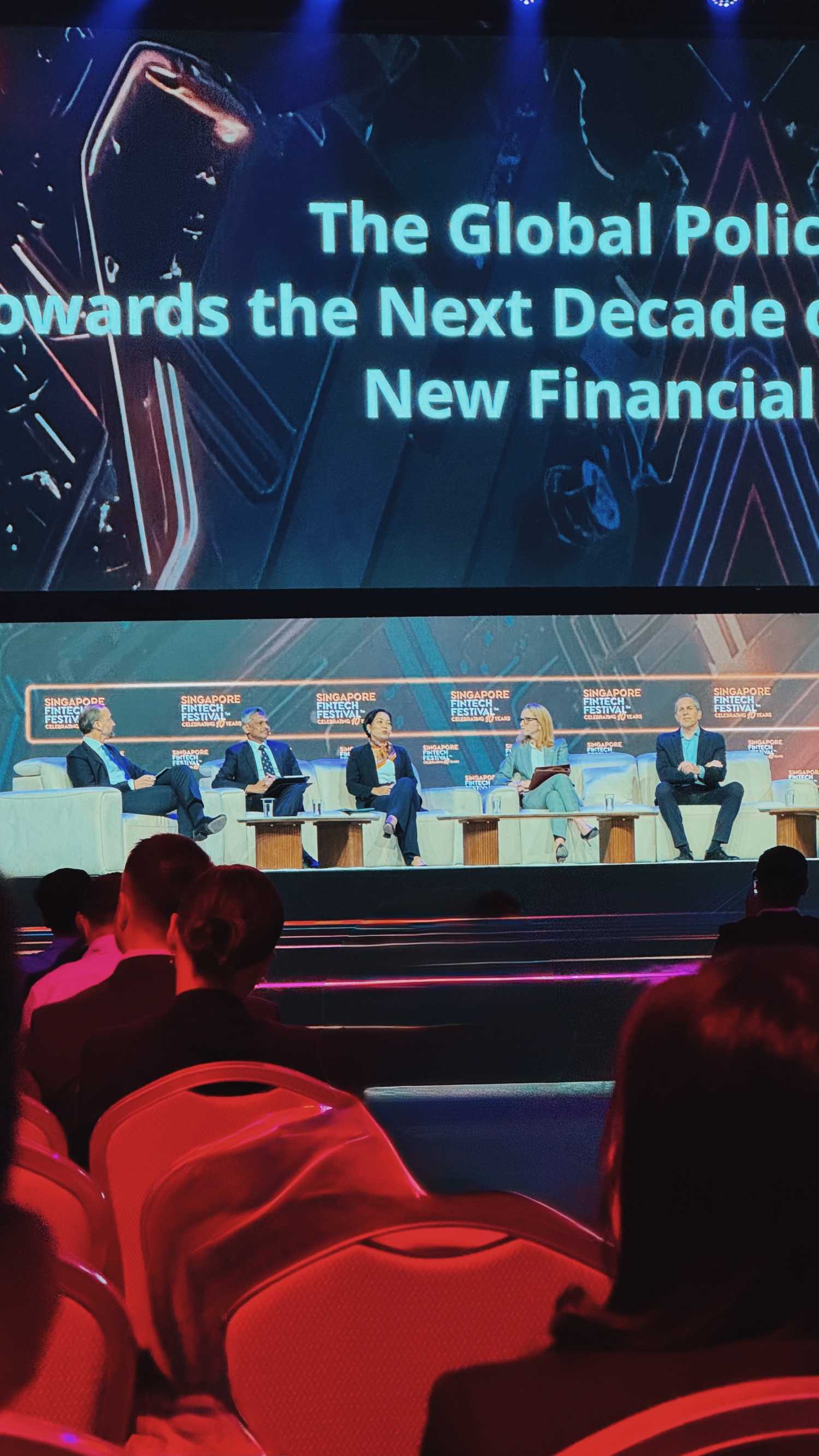
Introduction – A Banker at the World's Biggest FinTech Festival 🌏
Seven months after walking the floor at Black Hat Asia, I was back in Singapore — this time not for the offensive-security frontline, but for the other half of the picture: where the future of money actually gets built. Singapore FinTech Festival 2025 is the world's largest fintech gathering, and attending on behalf of the Digital and DevOps team at company gave me a front-row seat to the technologies reshaping the next decade of banking. This is the second entry in my conference-debrief series — same format, different battlefield. Less about how systems get broken, more about how programmable money, tokenisation, and AI-driven financial crime are changing what a bank has to build. Here's what I heard, and what each theme means when you have to turn it into architecture.
1. Landing in Singapore ✈️
From Phnom Penh back to the Singapore EXPO, 12 to 14 November 2025. This year was the festival's 10th anniversary, themed "Shaping the Next Decade of Growth" — and the scale is hard to overstate. Over 800 speakers across 400-plus sessions, organised by the Monetary Authority of Singapore (MAS), the Global Finance and Technology Network, and Constellar, in collaboration with the Association of Banks in Singapore. Last year's edition drew 65,000 people from 134 countries. If Black Hat is where you learn what can go wrong, SFF is where you see what everyone is racing to build. For an engineer from a Cambodian bank, walking those halls is a reminder that the gap between a regional bank and a global one isn't ambition — it's execution. Here's what stood out.
2. The Grand Sponsors – Who Powered the Festival 🏛️
You can read a festival by who pays for the stage. SFF 2025's sponsor floor was a map of where global finance is consolidating — payments networks, super-app ecosystems, and the cloud underneath all of them. AWS was a Platinum sponsor, and that placement is no accident — the cloud platform with 200-plus services is the infrastructure most of the fintech floor actually runs on, from data and AI platforms to core banking workloads. Their sessions on AI-ready data architecture were a reminder that behind every tokenisation demo is someone's compute bill. On the payments side, the heavyweights showed up in force: Ant Group and its international arm Ant International — the powerhouse behind Alipay — pushing financial inclusion and global payments; Tencent, the ecosystem behind WeChat Pay and TenPay; and the two card networks that still move most of the world's money, VISA (210-plus markets, B2B Connect) and Mastercard (trust, interoperability, and secure transactions at global scale). 🔒 Debrief for the enterprise. The convergence is the signal: super-apps, card networks, and hyperscalers are no longer in separate lanes. For a regional bank, the lesson is to pick your cloud and your payment partners as deliberately as your ledger — because increasingly they are the same strategic decision.
3. The Five Frontiers 🛰️
MAS framed the decade ahead around five frontiers, and they map almost perfectly onto a bank's roadmap. First, AI's Next Frontier — the shift from experimentation into production: underwriting, fraud detection, customer-service automation, risk management. The hard part isn't the model; it's the governance around it — monitoring for model drift, operational resilience, compliance, and transparency. Second, Tokenisation — representing money, deposits, and securities as programmable tokens on shared ledgers, unlocking faster and cheaper financial flows. Third, Settlement Assets — CBDCs, stablecoins, and tokenised deposits as the rails for trusted, interoperable global payments. MAS itself is trialling tokenised government bills and cross-border settlement. Fourth, Quantum Finance — preparing for "Q-Day," the point at which quantum computing could break today's encryption. For a bank, that's not science fiction; it's a migration plan we need to start scoping now. Fifth, Financial Inclusion — extending digital finance to the 1.4 billion people still unbanked, through interoperable, inclusive infrastructure. In a market like Cambodia, this one isn't abstract. 🔒 Debrief for the enterprise. These five aren't separate bets — they converge. Tokenised settlement only matters with AI-grade fraud controls, quantum-resilient encryption, and inclusive rails underneath it. Plan them as one architecture, not five projects.
4. Tokenisation in Production – The DBS Showcases 🪙
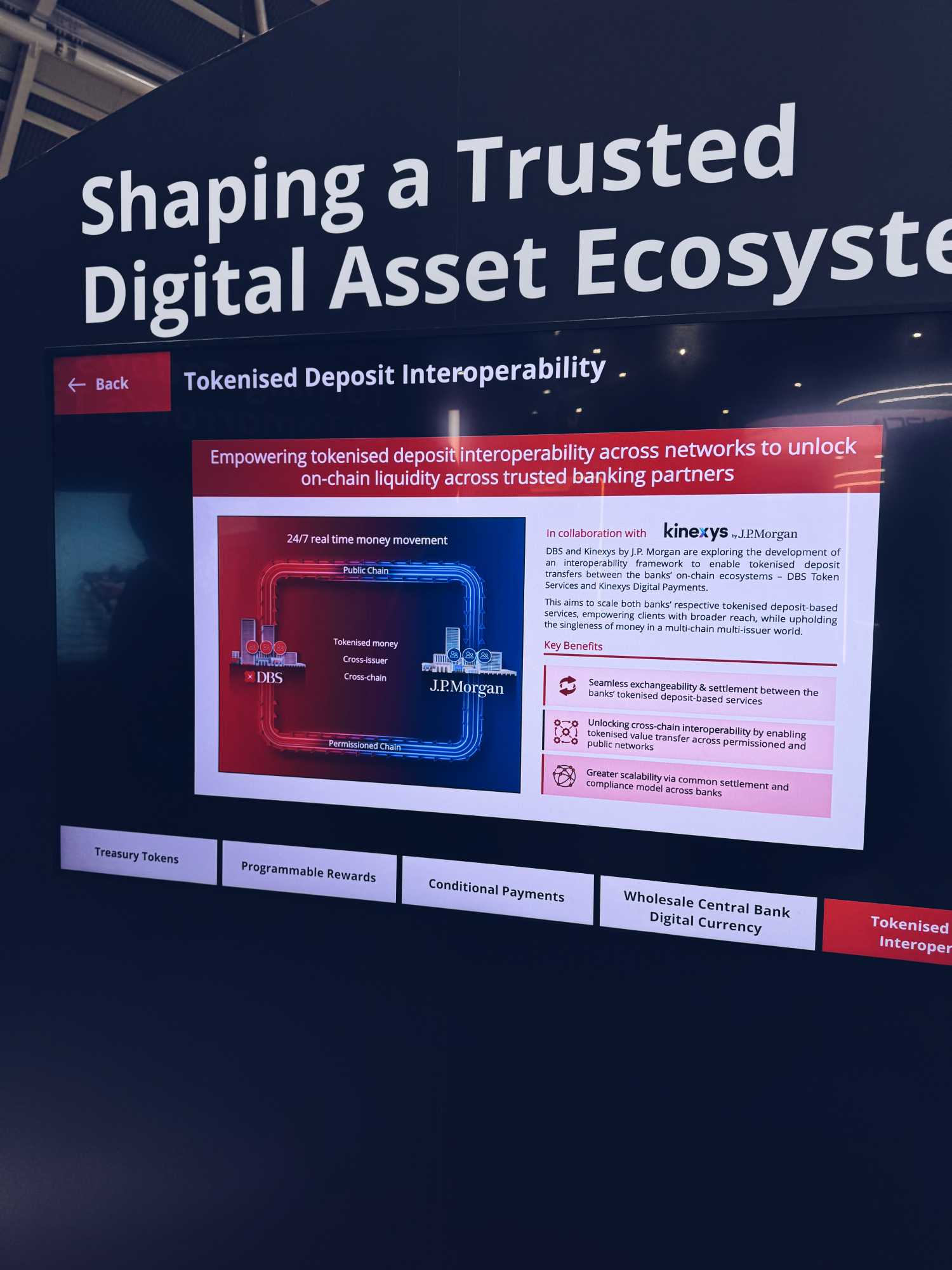
The most instructive sessions came from DBS, which has moved tokenisation out of the lab and into live products — all running on its own permissioned blockchain wired into its core payments engine. Treasury Tokens, built with Ant International, give corporate treasuries real-time, 24/7 liquidity management across multiple markets. Programmable Rewards — smart-contract-powered digital vouchers issued through the DBS PayLah! app, redeemable across merchants and integrated with national rails like NETS QR and the SGQR label. Conditional Payments — a pilot with Enterprise Singapore for programmable government grant disbursements, where funds release only when conditions are met, giving agencies governance and an audit trail by design. And Kinexys by J.P. Morgan — DBS and Kinexys exploring an interoperability framework so tokenised deposits can settle across both public and permissioned chains. 🔒 Debrief for the enterprise. The pattern is clear: the winners aren't issuing speculative crypto — they're tokenising real deposits on permissioned ledgers tied to existing payment rails. Interoperability, not novelty, is the moat.
5. The Tech Beneath – Blockchain, DLT, and Fabric ⛓️
This was the session I had been waiting for, because it's where I actually build. The deck untangled the terms people use interchangeably: all blockchains are DLTs, but not all DLTs are blockchains. DLT is the umbrella — a shared, synchronised ledger across nodes — and blockchain is one shape of it. For smart contracts, the landscape splits three ways: public blockchains (Bitcoin, Ethereum, Solana, Polygon), non-blockchain DLTs (Corda, Hedera, IOTA), and permissioned blockchains (Hyperledger Fabric, Quorum). Banks live almost entirely in that third category — and MAS itself runs DLT-based settlement layers, not crypto. The reason is throughput. Strip out mining, public validation, and decentralised-consensus overhead, and the numbers change completely: Hyperledger Fabric realistically does 1,000 to 20,000 TPS, and Fabric X pushes past 20,000 — against Ethereum's 15 to 30 on layer one. Having built on Fabric myself, those figures aren't marketing to me; permissioned, modular, and compliant is exactly why it shows up at IBM, Walmart, VISA's B2B Connect, and HSBC. 🔒 Debrief for the enterprise. For regulated banking, permissioned DLT wins on the axes that matter — speed, privacy, and compliance — precisely because it gives up the decentralisation a bank never wanted. Know which ledger you're choosing, and why.
6. The Fraud Arms Race – LexisNexis vs ComplyAdvantage 🕵️
The fraud and financial-crime track hit closest to work I've actually shipped. Two vendors anchored it. LexisNexis brings a deep stack — fraud and mule detection, identity verification, risk-based authentication, behavioural intelligence through its Digital Identity Network, and deepfake detection — fronted by a mobile app SDK that, to a builder, looks a lot like Firebase analytics events. In the Q and A they were candid about mule accounts: how accounts get hijacked or procured, and the device-farming "fraud farming" operations behind them. ComplyAdvantage leans into AML and detection logic — dynamic thresholds that adapt to criminal behaviour, explainability for every alert, identity clustering, and graph network detection that traces illicit fund flows across accounts. No mobile SDK; SaaS on AWS and Azure, with on-prem reserved for clients in India. The clearest takeaway was the mechanics of laundering itself: smurfing (initial placement in small transactions, dispersed across numerous accounts) and layering (obscuring the trail, then consolidating). If you've ever built link-analysis over transaction and account data, the graph-network framing is exactly the right mental model. 🔒 Debrief for the enterprise. Rules catch yesterday's fraud; graph and behavioural signals catch tomorrow's. The decisive question for any vendor is explainability — an alert your analysts and regulators can't reason about is a liability, not a control.
7. What a Bank Actually Needs 🏦
Sitting through the vendor pitches, our Digital division's evaluation criteria for fraud detection and AML came into sharp focus — and they're unapologetically enterprise-bank requirements, not startup defaults. The non-negotiables: on-premise deployment, transaction monitoring over full transaction histories, payment and behavioural screening, alerting, and audit and reporting. The integration surface: REST API webhooks, an optional mobile SDK, and BFF API access logs shipped through Elasticsearch. And the parts that separate a bank-grade tool from a merely convenient one: no telemetry — no metadata quietly leaving our perimeter — a transparent rules library, and the ability to build our own custom rules. For a regulated, air-gapped environment, those last three are the whole game. 🔒 Debrief for the enterprise. Vendor capability is the easy part; deployment posture is the hard one. On-prem, no telemetry, and custom rules aren't nice-to-haves for a bank — they're the difference between a tool you can run and a contract you can't sign.
8. What I Brought Home 🎒
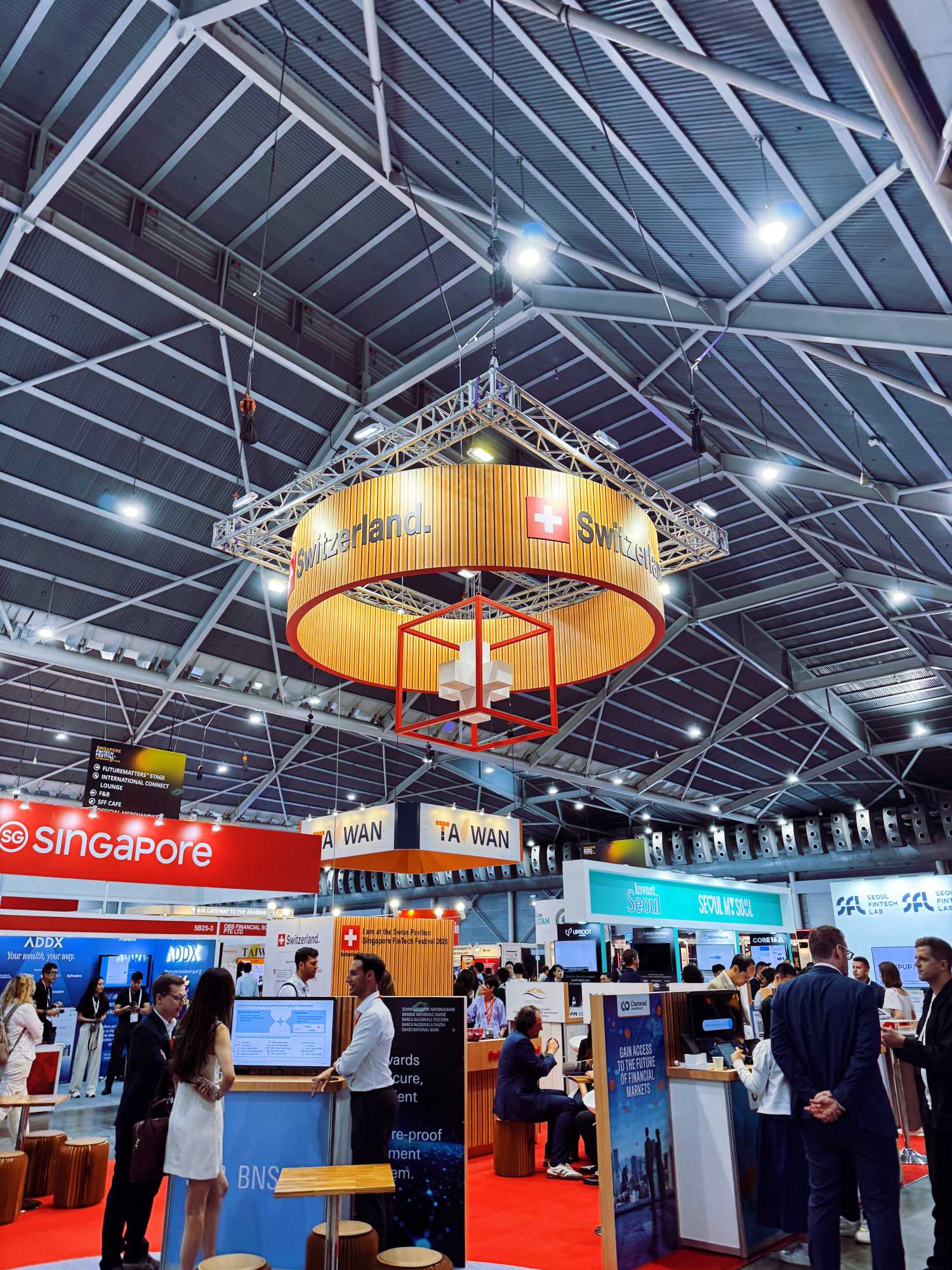
Black Hat showed me how the trusted thing turns hostile. SFF showed me what we're racing to build before it does. The two are the same job from opposite ends. The throughline of the festival was MAS's own framing — responsible AI adoption and a tokenised future — and underneath both sits the engineering reality I keep returning to: permissioned, governed, auditable, and built to a regulator's standard. The future of money is programmable. Our job is to make it programmable and trustworthy at the same time.
Conclusion – Shaping the Next Decade 🚀
Ten years of this festival, and the message for the next ten is that finance and technology are no longer two industries — they're one. Tokenisation, AI, and quantum-resilient security aren't separate roadmaps; they're the same architecture viewed from different angles. I flew home convinced that the regional banks who treat them as one system, not five pilots, are the ones still standing in 2035.
Final Note 🏁
If you're an engineer wondering whether these festivals are worth the trip — they are, but not for the keynotes. Go for the Q and A, the vendor floor, the unguarded technical conversations. That's where you learn what's real, what's marketing, and what your institution actually needs to build next.
#SingaporeFintechFestival #SFF2025 #FinTech #Tokenisation #Blockchain #HyperledgerFabric #DLT #FraudPrevention #AML #DigitalBanking #DevOps #FinancialInclusion